Showing posts with label black people. Show all posts

Tuesday, July 21, 2009

Aids Vaccine Funding Cut in South Africa

South Africa


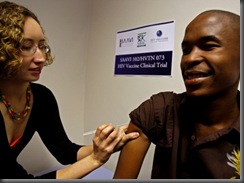
South Africa's government joined Monday in launching a high-profile trial of an AIDS vaccine created by its own researchers -- the first designed by a developing country -- but the moment was marred by the lead researcher's announcement it has actually halted funding its own project.

It was a jarring development in a nation whose politicians have a history of unscientific responses to the epidemic. Attempts to get an explanation from the government were not immediately successful.

Monday's announcement was meant to be a proud occasion for a nation where politicians have a history of unscientific responses to the epidemic. But after a government minister lauded the project, Professor Anna-Lise Williamson, the scientist heading the research, said the state had pulled the plug on its funding.


Click here to read more

Tuesday, October 7, 2008

Your Black Life: Does Racial "Colorblindness" Do More Harm Than Good?


The tendency of some white people to go silent or act "colorblind" on the topic of race could do more harm than good, new research shows.

White people — including children as young as 10 — may avoid talking about race so as not to appear prejudiced, but that approach often backfires as black people tend to view this approach as evidence of prejudice, especially when race is clearly relevant.

These results are from two separate sets of experiments led by researchers from Tufts University and Harvard Business School. Their findings are reported in the October issue of the Journal of Personality and Social Psychology and the September issue of Developmental Psychology.

"Efforts to talk about race are fraught with the potential for misunderstandings," said researcher Evan Apfelbaum, a Ph.D. candidate at Tufts University. "One way that whites try to appear unbiased is to avoid talking about race altogether, a tendency we refer to as strategic colorblindness."
Continued:

Monday, August 4, 2008

YourBlackLife: Black TV- How It Is vs. How We Want It To Be


By Chiderah A. Monde

W.E.B Du Bois and Alain Locke had contrasting ideas about how Black life should be portrayed by Black Art. In theatre, Du Bois’s plays depicted black life as it was: political propaganda, with struggling or less wealthy black families, self-taught intellectualism, and challenges of oppression. Locke’s plays reflected Black life as he thought it should be: successful and happy, with wealth, political equality and the triumphant black families.

Such views of Black life today have maintained similar contrasts, except now we’ve seen the same on television. Black sitcoms have made their way into the two categories that reflect Locke and DuBois’s contrasting beliefs.

For example, shows like “The Cosby Show”, “The Jeffersons”, “Family Matters”, and “Fresh Prince of Bel Air” portray Black life as we generally want it to be. The shows all have the successful and triumphant families aspect. There’s overall wealth and political equality (although sometimes there were episodes that showed the reality of racism), a tight-knit family that always worked through their problems, and most importantly, the stress of higher education for the shows with children- whether it is going to an Ivy League school or an HBC.

Shows like “Different Strokes”, “Living Single”, “All Of Us”, and now “House of Payne” portray Black life as it is in reality. There’s extended, multi-generational or broken families present in each sitcom, which reflects the truth that most Black families go beyond just the “nuclear” two parents and children model. There are also day-to-day (multi episode) struggles, lessons learned, and realizations of each character’s roles in the family and in society (like coming from a tough neighborhood or broken family). There isn’t necessarily a focus on the colleges that the characters go or went to, but more so a focus on the jobs they now hold.

It is no question that both televised ideas of Black life illustrate and reflect actual Black life. The ongoing argument of which one is more necessary can be satisfied by the successful ratings of both types of television sitcoms. I think both are very necessary, because there is factual support that shows like “The Cosby Show” increased enrollment in historically Black colleges and universities, and shows like “Living Single” (and later “Girlfriends”) have made it acceptable for Black women to be single and still successful.

Although these two theories of Black television summarize just about every Black sitcom, there are exceptions and characters of shows that fall into both categories. More importantly, as we move forward with the “life as it is” type of shows, there are still remnants of inferiority on television. There are now fewer shows that model Locke’s idea of “life as we want it to be” than there were in the 1970s and 1980s, and now most shows depict Du Bois’s “life as it is” with Black people having to teach themselves and their families how to get by and maintain values within society.

The lack of the “perfect” or Cosby-like Black family on today’s television could be related to the wake-up call that Black people are no longer living like this. “That’s So Raven” was cancelled, “Romeo” was cancelled, “Smart Guy”, “One on One” and “Sister, Sister” were cancelled, and so was almost every show that young Black children watched on Disney and Nickelodeon to see traces of happy families and wealthy Black people. The so-called “reality” show “Baldwin Hills” on BET is the closest we’re getting to seeing Black people live lavishly on television, and to be honest- it is not a good look. Is it better to have more black characters mixed happily into white television shows? Perhaps in our day and age we have to, since we apparently cannot combat the idea that Black people just don’t live happily, successfully, lavishly and with full families anymore.
Tuesday, July 29, 2008

The Africa You Don't See On TV

I was born in Lagos, Nigeria, and raised in other countries still feeling extremely connected to my heritage. My parents did a great job of making sure I knew a lot about my family, the place I was born, and the problems that face the people of Nigeria. Over the years, being in America has immersed me in Black culture. Seldom is there even recognition of Africans in America, and often times if there is- it tends to be negative.

I once encountered a professor who explained a theory he had that Black Americans have been taught to turn their noses up to Africans, and vice versa. The divide between the two has been implemented and encouraged, used as another strategy by the dominant race to keep Black people from uniting and incapable of taking over. It is another divide much like the dark skinned vs. light skinned fight, the college educated vs. the non college educated, wealthy Blacks vs. the working class, Black Republicans vs. everybody else, Haitians vs. Dominicans...and so on.

James Baldwin discussed the difference between Blacks and Africans in Europe in "Notes of A Native Son" and the unfortunate differences that keep us all- those of African descent- from understanding each other. Although the differences are too often swept under the rug, like most conflicts between races, there are tons of misconceptions and stereotypes about Africans and the continent of Africa.

I came into the first day back to 5th grade in Baltimore with a young British accent (having moved from London the previous year) and a deep tan (having spent time vacationing in Nigeria over winter break) ready for the show and tell portion of class. I had pictures from my trip: of my family's estate, my cousins' school, the family horseback riding on Bar Beach, pictures of the city of Lagos, etc....and they were welcomed with the most outlandish questions from my classmates.

I was asked, "Did you live in a hut?" to which I replied, no- we have houses.

"Do people wear loin cloths?" no, we have clothing. My aunt owns her own clothing line and store.

"Does your uncle hunt lions for a living?" no, actually he works for a major Oil company there.

And a plethora of equally ignorant questions. I cannot blame my classmates for these questions, I blame society. I blame the media for only ever showing one side of Africa (although it is SO VERY IMPORTANT- I am a huge advocate for change in my continent) and for never highlighting the beautiful things about this continent.

Africa is the most underrated continent on Earth. It was a rich and beautiful land stripped of many of it's resources by the Western world, and given no credit for any of its' people's accomplishments. It is home to tons of stolen art, food, mathematical, scientific and medicinal discoveries, and of course- beautiful people.

That being said, I found this YouTube video about the Africa they never show on TV: